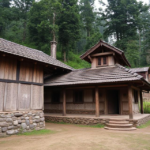
The architectural heritage of Daman, Diu, and Dadra & Nagar Haveli conveys a rich amalgamation of Portuguese colonial heritage, indigenous tribal architecture, and contemporary interventions.

The architectural heritage of Daman, Diu, and Dadra & Nagar Haveli conveys a rich amalgamation of Portuguese colonial heritage, indigenous tribal architecture, and contemporary interventions.
The Andaman and Nicobar Islands, a union territory of India, comprise 572 islands, of which only 38 are inhabited. The name “Andaman” likely derives from Handuman, linked to Hanuman from the Ramayana, while Nicobar originates from the Tamil Nakkavaram, meaning “open land.” The islands were referenced in historical records by Ptolemy, Marco Polo, and Chinese sources.
Brief summary and quick access to the articles on the architecture of Indian States.
Arunachal Pradesh, nestled in the northeastern Himalayas of India, is a living tapestry of architectural heritage deeply intertwined with its natural landscape and cultural richness.
It’s not just Chhath Puja and Litti Chokha, that make Bihar unique, but there a lot of historic and architectural marvels that add on to Bihar’s legacy.
The vernacular architecture of Chhattisgarh exemplifies a sustainable lifestyle deeply rooted in the region’s tribal traditions and natural resources.
Haryana’s architecture reflects a rich cultural heritage shaped by various civilizations, from the Indus Valley and Vedic periods to the Mughal era and British colonial rule. The state showcases an array of structures, including temples, forts, palaces, and modern buildings, making it a source of inspiration for architects and historians alike.
Himachal Pradesh, nestled in the majestic Himalayas, boasts an architectural heritage that reflects its rich cultural tapestry and mountainous terrain. The region’s architecture is a blend of indigenous styles and influences from Tibetan, Buddhist, and Hindu traditions.
Jharkhand’s temples reflect a unique architectural journey, marked by geometric and organic stone carvings that enhance the state’s religious and aesthetic heritage.
Karnataka’s architectural history spans from the Neolithic period, around 2000 BCE, when it evolved from simple shelters to ritualistic and religious structures. Early Neolithic people built huts using wattle and daub, supported by stone and bamboo, as seen in archaeological sites like Brahmagiri. The early Iron Age introduced megalithic stone burials, laying the groundwork for lasting architectural styles.